Showing posts with label OSHA Inspection. Show all posts

Wednesday, October 12, 2016

Fire Safety and Extinguisher Use in Healthcare Facilities

FIRES IN HEALTHCARE FACILITIES


In 2006-2010, U.S. fire departments responded to an estimated average of 6,240 structure fires in or on health care properties per year. These fires caused an average of six civilian deaths, 171 civilian injuries and $52.1 million in direct property damage annually. Almost half (46%) were at nursing homes, and almost one-quarter (23%) were in hospitals or hospices. Cooking equipment was involved in three out of five (61%) fires; dryers were involved in 7%, 6% were intentionally set; another 6% were started by smoking materials, and heating equipment was also involved in 6%. Only 4% of these fires spread beyond the room of origin. Causes, circumstances, and extent of fire spread varied by occupancy.

This graphic provides estimates of fire frequency and associated losses for reported fires in: all health care properties; in nursing homes; in hospitals or hospices; in mental health facilities caring for those with developmental disabilities, mental retardation, mental illness or substance abuse issues; and in clinics or doctors’ offices. Estimates were derived from NFPA’s fire department survey and the USFA’s National Fire Incident Reporting System (NFIRS).
Introduction to Fire and the Proper Use and Maintenance of Extinguishers

This is The Fire Triangle. Actually, it's a tetrahedron, because there are four elements that must be present for a fire to exist. There must be oxygen to sustain combustion, heat to raise the material to its ignition temperature, fuel to support the combustion and a chemical reaction between the other three elements.
Remove any one of the four elements to extinguish the fire.
The concept of Fire Protection is based upon keeping these four elements separate.

Types of Fires

Not all fires are the same. Different fuels create different fires and require different types of fire extinguishing agents.

Class A Class A

Class A fires are fires in ordinary combustibles such as wood, paper, cloth, trash, and plastics.

Class B Class B

Class B fires are fires in flammable liquids such as gasoline, petroleum oil and paint. Class B fires also include flammable gases such as propane and butane. Class B fires do not include fires involving cooking oils and grease.

Class C Class C

Class C fires are fires involving energized electical equipment such as motors, transformers, and appliances. Remove the power and the Class C fire becomes one of the other classes of fire.

Class D Class D

Class D fires are fires in combustible metals such as potassium, sodium, aluminum, and magnesium.

Class K Class K

Class K fires are fires in cooking oils and greases such as animals fats and vegetable fats.
Some types of fire extinguishing agents can be used on more than one class of fire. Others have warnings where it would be dangerous for the operator to use a particular fire extinguishing agent.

Types of Fire Extinguishers

Water and foam extinguishers Water and Foam

Water and Foam fire extinguishers extinguish the fire by taking away the heat element of the fire triangle. Foam agents also separate the oxygen element from the other elements.
Water extinguishers are for Class A fires only - they should not be used on Class B or C fires. The discharge stream could spread the flammable liquid in a Class B fire or could create a shock hazard on a Class C fire.

CO2 Extinguisher Carbon Dioxide

Carbon Dioxide fire extinguishers extinguish fire by taking away the oxygen element of the fire triangle and also be removing the heat with a very cold discharge.
Carbon dioxide can be used on Class B & C fires. They are usually ineffective on Class A fires.

Dry Chemical

Dry ChemicalDry Chemical fire extinguishers extinguish the fire primarily by interrupting the chemical reaction of the fire triangle.
Today's most widely used type of fire extinguisher is the multipurpose dry chemical that is effective on Class A, B, and C fires. This agent also works by creating a barrier between the oxygen element and the fuel element on Class A fires.
Ordinary dry chemical is for Class B & C fires only. It is important to use the correct extinguisher for the type of fuel! Using the incorrect agent can allow the fire to re-ignite after apparently being extinguished successfully.

Wet Chemical Extinguisher Wet Chemical

Wet Chemical is a new agent that extinguishes the fire by removing the heat of the fire triangle and prevents re-ignition by creating a barrier between the oxygen and fuel elements.
Wet chemical of Class K extinguishers were developed for modern, high efficiency deep fat fryers in commercial cooking operations. Some may also be used on Class A fires in commercial kitchens.

Clean Agent
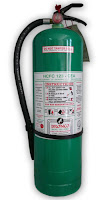
Halon

Halogenated or Clean Agent extinguishers include the halon agents as well as the newer and less ozone depleting halocarbon agents. They extinguish the fire by interrupting the chemical reaction of the fire triangle.
Clean agent extinguishers are primarily for Class B & C fires. Some larger clean agent extinguishers can be used on Class A, B, and C fires.

Dry Powder

Dry Powder extinguishers are similar to dry chemical except that they extinguish the fire by separating the fuel from the oxygen element or by removing the heat element of the fire triangle.
However, dry powder extinguishers are for Class D or combustible metal fires, only. They are ineffective on all other classes of fires.

Water Mist
Water Mist extinguishers

Water Mist extinguishers are a recent development that extinguish the fire by taking away the heat element of the fire triangle. They are an alternative to the clean agent extinguishers where contamination is a concern.
Water mist extinguishers are primarily for Class A fires, although they are safe for use on Class C fires as well.

Cartridge Operated Dry Chemical
Cartridge-Operated Dry Chemical extinguishers

Cartridge Operated Dry Chemical fire extinguishers extinguish the fire primarily by interrupting the chemical reaction of the fire triangle.
Like the stored pressure dry chemical extinguishers, the multipurpose dry chemical is effective on Class A, B, and C fires. This agent also works by creating a barrier between the oxygen element and the fuel element on Class A fires.
Ordinary dry chemical is for Class B & C fires only. It is important to use the correct extinguisher for the type of fuel! Using the incorrect agent can allow the fire to re-ignite after apparently being extinguished successfully.

Fire Extinguisher Chart

The Rules for Fighting Fires

Just remember the three A's

ACTIVATE the building alarm system or notify the fire department by calling 911. Or, have someone else do this for you.
ASSIST any persons in immediate danger, or those incapable on their own, to exit the building, without risk to yourself.
Only after these two are completed should you ATTEMPT to extinguish the fire.

Only fight a fire if:

  • The fire is small and contained
  • You are safe from toxic smoke
  • You have a means of escape
  • Your instincts tell you it's OK

Fire Extinguisher Use

  • It is important to know the locations and the types of extinguishers in your workplace prior to actually using one.
  • Fire extinguishers can be heavy, so it's a good idea to practice picking up and holding an extinguisher to get an idea of the weight and feel.
  • Take time to read the operating instructions and warnings found on the fire extinguisher label. Not all fire extinguishers look alike.
  • Practice releasing the discharge hose or horn and aiming it at the base of an imagined fire. Do not pull the pin or squeeze the lever. This will break the extinguisher seal and cause it to lose pressure.
When it is time to use the extinguisher on a fire, just remember PASS!
Pull the pin.
Aim the nozzle or hose at the base of the fire from the recommended safe distance.
Squeeze the operating lever to discharge the fire extinguishing agent.
Starting at the recommended distance, Sweep the nozzle or hose from side to side until the fire is out. Move forward or around the fire area as the fire diminishes. Watch the area in case of re-ignition.
Fire Extinguisher Inspection
Like any mechanical device, fire extinguishers must be maintained on a regular basis to ensure their proper operation. You, the owner or occupant of the property where the fire extinguishers are located, are responsible for arranging your fire extinguishers' maintenance.
Fire extinguishers must be inspected or given a "quick check" every 30 days. For most extinguishers, this is a job that you can easily do by locating the extinguishers in your workplace and answering the three questions below.
  • Is the extinguisher in the correct location?
  • Is it visible and accessible?
  • Does the gauge or pressure indicator show the correct pressure?

Fire Extinguisher Maintenance

In addition, fire extinguishers must be maintained annually in accordance with local, state, and national codes and regulations. This is a thorough examination of the fire extinguisher's mechanical parts, fire extinguishing agent, and the expellent gas. Your fire equipment professional is the ideal person to perform the annual maintenance because they have the appropriate servicing manuals, tools, recharge materials, parts, lubricants, and the necessary training and experience.
Fire Safety Preparation and Followup
Ensure that your ENTIRE staff has completed their OSHA compliance training. Verify that your OSHA Compliance Officer and/or HR department have properly done the following:
  • Have all fire safety alarms, detectors, exit signs, fire doors, emergency lights, etc. Properly inspected by qualified building maintenance staff and/or the local fire department.
  • Developed safe emergency evacuation routes and have these posted in readily available areas visible to both staff and patients.
  • Have regular fire drills and instruct employees on the use of alarms, extinguishers, and other emergency procedures in your Fire Safety Plan.
  • Train with your staff often enough that they feel confident and knowledgeable in the event of an emergency. Fires happen and move quickly. Your staff needs to know how to notify 911, and move themselves and patients quickly and efficiently to a safe location.
For more information on protecting your office regarding this issue or additional HIPAA, OSHA, HR, and Medicare resources, please visit our web site: http://www.hcsiinc.com or email support at support@hcsiinc.com.


To subscribe to this blog, enter your email address:


Delivered by FeedBurner

Tuesday, December 8, 2015

Protecting Employees from Workplace Violence

Being Aware and Having an Emergency Action Plan

The December 2nd, 2015 shooting in San Bernardino California, where 14 people were shot to death and 21 were injured at an office gathering, is a sobering reminder that violence in the workplace is an issue of concern for all of us. For employers, it is critical to ensure that all employees know the company's safety and violence prevention policies and procedures. In addition, companies can offer additional protections:

Hiring

  • Verify information on all new hires through reference checking.
  • Screen applicants by conducting background checks. Condition offers of employment upon the completion of background checks, drug tests or medical exams.
  • Review workers’ compensation records and illness claims to identify patterns of assault or other workplace violence. Understand industry trends and specific job exposures.

Employment

  • Have a clear, written policy protecting employees from harassment, threats and intimidation. Policies should note that any complaints of harassment or threats will be investigated fully and appropriate steps taken, including discipline and discharge.
  • Establish a complaint/grievance procedure.
  • Establish/communicate how to access employee assistance program (EAP) services.
  • Offer outplacement counseling to employees being laid off or terminated.

Security

  • Consider implementing the following security measures: monitoring systems, limited access key cards, employee identification cards, emergency warning systems, security guards, visitor sign-in policies, security escorts in case of emergencies.

Crisis Plan

Develop a crisis plan that outlines how to report incidents of workplace violence, instructions on who to notify and:

  • How to assess the situation, get help, warn other employees and secure the workplace.
  • When and how to involve the police and gather information to assist an investigation.
  • Follow-up activities like debriefing employees, resuming operations and long-term planning.
All employers should and probably do maintain an evacuation plan, but few employees even drill about the plan.  Moreover, responding to a tornado, hurricane or other natural disaster is far different from responding to a fire, explosion, shooting, or collapse of the electrical grid. 
  •          Have you as an employer even thought about how you should respond to such events and protect your employees? 
  •          Do you maintain an Emergency Ection Plan (EAP) under OSHA regulations? 
  •          Do you even know what triggers the obligation to have an EAP?
There is much talk about workplace violence, but have you assessed your operation to determine where risks are presented?  Do you have employees making deliveries or going to customers’ homes unaccompanied? Have you professionally assessed security for entrance and exits?  Do management and HR know when they should be concerned about potentially dangerous employee behavior and what to do next?

If your answer is to simply point to the binder on a shelf or to be self assured that you have “competent people to take care of such matters,” then perhaps it is time to roll up your sleeves and check.
OSHA Focus on Workplace Violence

If you want additional motivation, OSHA is dead serious about inspecting employers for workplace violence exposures and issuing citations under its general duty powers. 

Special Focus on Workplace Violence in Healthcare

OSHA is also quite serious about conducting health care and hospital inspections which focus on workplace violence and ergonomic concerns.
See Also
Image credit: Chris Kuhlman 

For more information on this and other healthcare compliance topics related to HIPAA, OSHA, Medicare and HR, simply email your questions to support@hcsiinc.com
visit our website at http://www.hcsiinc.com or post a question on our LinkedIn group at: http://bit.ly/1FWmtq6

To subscribe to this blog, enter your email address:


Delivered by FeedBurner

Tuesday, November 3, 2015

OSHA Means Business Going Forward


OSHA Now Targeting The Health Care and Nursing Care Industries
Here’s more evidence your company needs to stay current on safety training: OSHA fines are heading skyward.  

Since 2010, the number of companies facing total OSHA fines above $100,000 has tripled.

This month, OSHA issued three penalties that topped one-million dollars and levied nearly a dozen citations carrying six-figure fines.

There’s more: Outgoing GOP house speaker John Boehner’s final peace offering – negotiating a compromised budget deal that would extend the debt limit and boost spending – took labor officials by surprise after finding that the agreement included a provision to hike OSHA fines nearly 50% in 2016.

The House approved the bill Oct. 28 and the Senate was scheduled to consider it Oct. 29. The bill includes a provision to adjust OSHA penalties annually based on the inflation rate.

Repeat and willful violations – which carry a maximum of $70,000 in penalties – contributed to the high dollar value of these fines. Machine guarding, lockout/tagout, trenching and fall hazards were among the common citations.

Here’s a sampling of October’s enforcement activities:
  • Regulators hit a Nebraska cleaning company with 30 citations and $963,000 in fines after a railcar exploded, killing two employees and injuring a third. OSHA said the company sent the workers to clean a tanker car filled with dangerous fumes despite warnings that the air quality inside the car showed a high risk of explosion.
  • Troubled Midwest furniture giant Ashley Furniture – already facing $1.7 million in OSHA fines from an inspection earlier this year – was hit for lockout/tagout hazards carrying $431,000 in penalties. In February, OSHA leveled 38 violations after inspectors discovered there were more than 1,000-work-related injuries at the plant over a 3 1/2 year period.
  • An Ohio chicken processing facility found itself facing $414,000 in fines after two workers were maimed while attempting to clean unguarded machines. Penalties levied against Case Farms now total over $1.4 million.
  • A commercial laundry company was hit with $305,300 in fines for repeatedly exposing workers to machine hazards. Three years ago, a 24-year old worker was killed when he was crushed by a conveyor belt.
  • osha finesOSHA orders pilot to be reinstated after being fired for refusing to fly unsafe medical transport helicopter
    A pilot working for Air Methods Corp. was illegally terminated for refusing to fly a medical transport helicopter with a faulty emergency locator transmitter. Following an investigation, OSHA ordered the company reinstate the pilot, pay $166,000 in back wages and damages and remove disciplinary information from the pilot’s personnel record. The company must also provide whistleblower rights information to all employees.
The Occupational Safety and Health Administration (“OSHA”) recently intensified its scrutiny of the health care and nursing care industries. On June 25, 2015, the agency announced a new enforcement initiative targeting inpatient health care and nursing care facilities. But this increased scrutiny of the health care and nursing care industries does not end there—OSHA is spreading its enforcement reach to other types of health care entities.
Recently, OSHA cited LifeFleet LLC, an Ohio medical patient transportation company, for training shortfalls and bloodborne pathogen violations. OSHA alleged multiple violations, including several costly willful violations, and is seeking fines totaling nearly $236,000—a notably large amount. Typically, the fines associated with OSHA citations are very low, unless they are associated with fatalities. There were no fatalities in this case.
In discussing the magnitude of the fines against LifeFleet, OSHA’s Cleveland Area Office Director Howard Eberts said, “Failing to protect workers from pathogens that can cause life-threatening diseases is unacceptable. As a medical service provider, LifeFleet should be setting the standard in employee protection – not ignoring it.”
What does this mean to health care and nursing care employers? OSHA is targeting all health care and nursing care facilities, not just inpatient facilities. The agency is sending a clear message to the health care and nursing care industries in issuing citations carrying unusually heavy fines.
Here are a few action steps that employers can take right now to prepare for an OSHA inspection:
  • Conduct an internal OSHA compliance audit. The cost of conducting an internal audit and addressing hazards before an OSHA inspection is trivial by comparison.
  • Review all health and safety training programs. Ensure that all employees have been thoroughly trained—and have received refresher training, when appropriate—on all aspects of the facility’s health and safety policies and that they can demonstrate that they understood the training. It is advisable to conduct a quiz after each training session in order for employees to demonstrate their comprehension of the training and to keep quiz results and training attendee lists on file.
  • Consult with an OSHA attorney regarding preparations for an OSHA inspection. Most health care and nursing care employers have never experienced an OSHA inspection (LifeFleet, for example, had never been inspected before) and may not be aware of strategies that can be used to minimize work disruption during an inspection and reduce the likelihood of receiving an unwarranted citation.
Sources:  - http://www.cfodailynews.comhttp://www.oshalawupdate.com/, http://www.dol.gov/ 


For more information on this and other healthcare topics related to HIPAA, OSHA, Medicare and HR compliance please email support@hcsiinc.com or visit our website at http://www.hcsiinc.com 
Join our LinkedIn group at: http://bit.ly/1FWmtq6

To subscribe to this blog, enter your email address:

Delivered by FeedBurner

Wednesday, October 28, 2015

OSHA Penalties

Types of OSHA Citations and Fines
                                                           
OSHA issues different types of citations, depending on the nature and severity of the violation. Penalties are proposed based on the type of violation.
                                                           
If you’re cited for OSHA violations following an inspection, penalties may vary depending on the type of citation. Note, however, that in settling a penalty, OSHA says it has a policy of reducing penalties for small employers and those acting in good faith.
                                                           
         ●       Willful
A willful violation exists under the OSH Act where an employer has demonstrated either an intentional disregard for the requirements of the Act or a plain indifference to employee safety and health. Penalties range from $5,000 to $70,000 per willful violation. If an employer is convicted of a willful violation of a standard that has resulted in the death of an employee, the offense is punishable by a court-imposed fine or by imprisonment for up to 6 months, or both. A fine of up to $250,000 for an individual, or $500,000 for a corporation, may be imposed for a criminal conviction.

       Serious
Section 17(k) of the OSH Act provides that “a serious violation shall be deemed to exist in a place of employment if there is a substantial probability that death or serious physical harm could result from a condition which exists, or from one or more practices, means, methods, operations, or processes which have been adopted or are in use, in such place of employment unless the employer did not, and could not with the exercise of reasonable diligence, know of the presence of the violation.” OSHA may propose a penalty of up to $7,000 for each violation.

        Other-Than-Serious
This type of violation is cited in situations where the accident/incident or illness that would be most likely to result from a hazardous condition would probably not cause death or serious physical harm, but would have a direct and immediate relationship to the safety and health of employees. OSHA may impose a penalty of up to $7,000 for each violation.

       De Minimis
De minimis conditions are those where an employer has implemented a measure different from one specified in a standard, that has no direct or immediate relationship to safety or health. These conditions do not result in citations or penalties.

       Failure to Abate
A failure to abate violation exists when a previously cited hazardous condition, practice or non-complying equipment has not been brought into compliance since the prior inspection (i.e., the violation remains continuously uncorrected) and is discovered at a later inspection. If, however, the violation was corrected, but later reoccurs, the subsequent occurrence is a repeated violation. OSHA may impose a penalty of up to $7,000 per day for each violation.

       Repeated
An employer may be cited for a repeated violation if that employer has been cited previously, within the last five years, for the same or a substantially similar condition or hazard and the citation has become a final order of the Occupational Safety and Health Review Commission (OSHRC). A citation may become a final order by operation of law when an employer does not contest the citation, or pursuant to court decision or settlement. Repeated violations can bring a civil penalty of up to $70,000 for each violation.

Additional violations for which citations and proposed penalties may be issued upon conviction:
•  Falsifying records, reports or applications can bring a fine of $10,000 or up to 6 months in jail, or both.
•  Violations of posting requirements can bring a civil penalty of up to $7,000.
•  Assaulting a compliance officer, or otherwise resisting, opposing, intimidating, or interfering with compliance officers while they are engaged in the performance of their duties is a criminal offense, subject to a fine of not more than $5,000 and imprisonment for not more than 3 years.

Don’t Take the Risk!
Why risk citations and penalties when you can ensure OSHA compliance with an affordable and effective compliance training program? For more information on this and other topics related to HIPAA, OSHA, Medicare and HR compliance please email support@hcsiinc.com or visit our website at http://www.hcsiinc.com 
Become a member of our LinkedIn group at: http://bit.ly/1FWmtq6

To subscribe to this blog, enter your email address:

Delivered by FeedBurner