Showing posts with label OSHA Complaint. Show all posts

Wednesday, October 12, 2016

Fire Safety and Extinguisher Use in Healthcare Facilities

FIRES IN HEALTHCARE FACILITIES


In 2006-2010, U.S. fire departments responded to an estimated average of 6,240 structure fires in or on health care properties per year. These fires caused an average of six civilian deaths, 171 civilian injuries and $52.1 million in direct property damage annually. Almost half (46%) were at nursing homes, and almost one-quarter (23%) were in hospitals or hospices. Cooking equipment was involved in three out of five (61%) fires; dryers were involved in 7%, 6% were intentionally set; another 6% were started by smoking materials, and heating equipment was also involved in 6%. Only 4% of these fires spread beyond the room of origin. Causes, circumstances, and extent of fire spread varied by occupancy.

This graphic provides estimates of fire frequency and associated losses for reported fires in: all health care properties; in nursing homes; in hospitals or hospices; in mental health facilities caring for those with developmental disabilities, mental retardation, mental illness or substance abuse issues; and in clinics or doctors’ offices. Estimates were derived from NFPA’s fire department survey and the USFA’s National Fire Incident Reporting System (NFIRS).
Introduction to Fire and the Proper Use and Maintenance of Extinguishers

This is The Fire Triangle. Actually, it's a tetrahedron, because there are four elements that must be present for a fire to exist. There must be oxygen to sustain combustion, heat to raise the material to its ignition temperature, fuel to support the combustion and a chemical reaction between the other three elements.
Remove any one of the four elements to extinguish the fire.
The concept of Fire Protection is based upon keeping these four elements separate.

Types of Fires

Not all fires are the same. Different fuels create different fires and require different types of fire extinguishing agents.

Class A Class A

Class A fires are fires in ordinary combustibles such as wood, paper, cloth, trash, and plastics.

Class B Class B

Class B fires are fires in flammable liquids such as gasoline, petroleum oil and paint. Class B fires also include flammable gases such as propane and butane. Class B fires do not include fires involving cooking oils and grease.

Class C Class C

Class C fires are fires involving energized electical equipment such as motors, transformers, and appliances. Remove the power and the Class C fire becomes one of the other classes of fire.

Class D Class D

Class D fires are fires in combustible metals such as potassium, sodium, aluminum, and magnesium.

Class K Class K

Class K fires are fires in cooking oils and greases such as animals fats and vegetable fats.
Some types of fire extinguishing agents can be used on more than one class of fire. Others have warnings where it would be dangerous for the operator to use a particular fire extinguishing agent.

Types of Fire Extinguishers

Water and foam extinguishers Water and Foam

Water and Foam fire extinguishers extinguish the fire by taking away the heat element of the fire triangle. Foam agents also separate the oxygen element from the other elements.
Water extinguishers are for Class A fires only - they should not be used on Class B or C fires. The discharge stream could spread the flammable liquid in a Class B fire or could create a shock hazard on a Class C fire.

CO2 Extinguisher Carbon Dioxide

Carbon Dioxide fire extinguishers extinguish fire by taking away the oxygen element of the fire triangle and also be removing the heat with a very cold discharge.
Carbon dioxide can be used on Class B & C fires. They are usually ineffective on Class A fires.

Dry Chemical

Dry ChemicalDry Chemical fire extinguishers extinguish the fire primarily by interrupting the chemical reaction of the fire triangle.
Today's most widely used type of fire extinguisher is the multipurpose dry chemical that is effective on Class A, B, and C fires. This agent also works by creating a barrier between the oxygen element and the fuel element on Class A fires.
Ordinary dry chemical is for Class B & C fires only. It is important to use the correct extinguisher for the type of fuel! Using the incorrect agent can allow the fire to re-ignite after apparently being extinguished successfully.

Wet Chemical Extinguisher Wet Chemical

Wet Chemical is a new agent that extinguishes the fire by removing the heat of the fire triangle and prevents re-ignition by creating a barrier between the oxygen and fuel elements.
Wet chemical of Class K extinguishers were developed for modern, high efficiency deep fat fryers in commercial cooking operations. Some may also be used on Class A fires in commercial kitchens.

Clean Agent
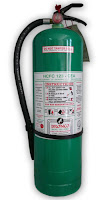
Halon

Halogenated or Clean Agent extinguishers include the halon agents as well as the newer and less ozone depleting halocarbon agents. They extinguish the fire by interrupting the chemical reaction of the fire triangle.
Clean agent extinguishers are primarily for Class B & C fires. Some larger clean agent extinguishers can be used on Class A, B, and C fires.

Dry Powder

Dry Powder extinguishers are similar to dry chemical except that they extinguish the fire by separating the fuel from the oxygen element or by removing the heat element of the fire triangle.
However, dry powder extinguishers are for Class D or combustible metal fires, only. They are ineffective on all other classes of fires.

Water Mist
Water Mist extinguishers

Water Mist extinguishers are a recent development that extinguish the fire by taking away the heat element of the fire triangle. They are an alternative to the clean agent extinguishers where contamination is a concern.
Water mist extinguishers are primarily for Class A fires, although they are safe for use on Class C fires as well.

Cartridge Operated Dry Chemical
Cartridge-Operated Dry Chemical extinguishers

Cartridge Operated Dry Chemical fire extinguishers extinguish the fire primarily by interrupting the chemical reaction of the fire triangle.
Like the stored pressure dry chemical extinguishers, the multipurpose dry chemical is effective on Class A, B, and C fires. This agent also works by creating a barrier between the oxygen element and the fuel element on Class A fires.
Ordinary dry chemical is for Class B & C fires only. It is important to use the correct extinguisher for the type of fuel! Using the incorrect agent can allow the fire to re-ignite after apparently being extinguished successfully.

Fire Extinguisher Chart

The Rules for Fighting Fires

Just remember the three A's

ACTIVATE the building alarm system or notify the fire department by calling 911. Or, have someone else do this for you.
ASSIST any persons in immediate danger, or those incapable on their own, to exit the building, without risk to yourself.
Only after these two are completed should you ATTEMPT to extinguish the fire.

Only fight a fire if:

  • The fire is small and contained
  • You are safe from toxic smoke
  • You have a means of escape
  • Your instincts tell you it's OK

Fire Extinguisher Use

  • It is important to know the locations and the types of extinguishers in your workplace prior to actually using one.
  • Fire extinguishers can be heavy, so it's a good idea to practice picking up and holding an extinguisher to get an idea of the weight and feel.
  • Take time to read the operating instructions and warnings found on the fire extinguisher label. Not all fire extinguishers look alike.
  • Practice releasing the discharge hose or horn and aiming it at the base of an imagined fire. Do not pull the pin or squeeze the lever. This will break the extinguisher seal and cause it to lose pressure.
When it is time to use the extinguisher on a fire, just remember PASS!
Pull the pin.
Aim the nozzle or hose at the base of the fire from the recommended safe distance.
Squeeze the operating lever to discharge the fire extinguishing agent.
Starting at the recommended distance, Sweep the nozzle or hose from side to side until the fire is out. Move forward or around the fire area as the fire diminishes. Watch the area in case of re-ignition.
Fire Extinguisher Inspection
Like any mechanical device, fire extinguishers must be maintained on a regular basis to ensure their proper operation. You, the owner or occupant of the property where the fire extinguishers are located, are responsible for arranging your fire extinguishers' maintenance.
Fire extinguishers must be inspected or given a "quick check" every 30 days. For most extinguishers, this is a job that you can easily do by locating the extinguishers in your workplace and answering the three questions below.
  • Is the extinguisher in the correct location?
  • Is it visible and accessible?
  • Does the gauge or pressure indicator show the correct pressure?

Fire Extinguisher Maintenance

In addition, fire extinguishers must be maintained annually in accordance with local, state, and national codes and regulations. This is a thorough examination of the fire extinguisher's mechanical parts, fire extinguishing agent, and the expellent gas. Your fire equipment professional is the ideal person to perform the annual maintenance because they have the appropriate servicing manuals, tools, recharge materials, parts, lubricants, and the necessary training and experience.
Fire Safety Preparation and Followup
Ensure that your ENTIRE staff has completed their OSHA compliance training. Verify that your OSHA Compliance Officer and/or HR department have properly done the following:
  • Have all fire safety alarms, detectors, exit signs, fire doors, emergency lights, etc. Properly inspected by qualified building maintenance staff and/or the local fire department.
  • Developed safe emergency evacuation routes and have these posted in readily available areas visible to both staff and patients.
  • Have regular fire drills and instruct employees on the use of alarms, extinguishers, and other emergency procedures in your Fire Safety Plan.
  • Train with your staff often enough that they feel confident and knowledgeable in the event of an emergency. Fires happen and move quickly. Your staff needs to know how to notify 911, and move themselves and patients quickly and efficiently to a safe location.
For more information on protecting your office regarding this issue or additional HIPAA, OSHA, HR, and Medicare resources, please visit our web site: http://www.hcsiinc.com or email support at support@hcsiinc.com.


To subscribe to this blog, enter your email address:


Delivered by FeedBurner

Friday, September 4, 2015

OSHA Needle-stick Injury Checklist

Needle-stick Injury Checklist

The following is a checklist for you to follow in the event of a needle-stick:
● Immediately wash the exposed area with soap and water.
● Notify your OSHA Compliance Officer.
● Notify doctor “of record” for the patient.
● If the source is known to be HIV positive, OR is at high risk, THIS IS AN EMERGENCY! (In this situation, the employee SHOULD have been double gloved!).
● Offer Chemoprophylaxis (PEP) within 1-2 hours.
● Obtain consent from “source“ to draw blood.
● Source Patient: Draw a “STAT” HIV screen, HBsAg, HbsAb, and Hep C Ab.
● The “STAT” HIV screen needs an EDTA (purple) tube, the rest require serum. One purple top and one 6-8 cc serum tube is needed.
● If the source is NOT infected with a bloodborne pathogen, no further baseline testing is required on the employee.
● Perform Anti-HCV and ALT testing in 4-6 months.
● A previously vaccinated known responder to HBV requires no further testing.
● Perform HIV-antibody testing at 6 weeks, 3 months, and 6 months post-exposure.
● Complete Sharps Injury Log.
● Lastly, complete your Post-Exposure Checklist.

Tuesday, September 1, 2015

OSHA Introduces Early Resolution Whistle Blower Program

An Early Resolution Program for Whistle-Blower Claims
In an attempt to save money and time, the federal Occupational Safety and Health Administration (OSHA) has introduced an early resolution program for whistle-blowers and employers to settle disputes without investigations and litigation. State OSHA plans are strongly encouraged to also adopt the process.
The early resolution process offers whistle-blower parties the opportunity to negotiate a settlement with the assistance of a neutral, confidential OSHA representative with subject matter expertise in whistle-blower investigations, the agency said. It’s an expansion of a pilot program that’s been in place in selected OSHA regions since late 2012.
OSHA enforces the whistle-blower provisions of 22 statutes protecting employees who report violations of various securities laws; trucking, airline, nuclear power, pipeline, environmental, rail, maritime, health care, workplace safety and health regulations; and consumer product safety laws.
“The number of retaliation claims filed under the various statutes has risen steadily each year and the cost of investigating them has placed a tremendous strain on OSHA’s fiscal and physical resources,” said Valerie Butera, a labor and employment attorney. OSHA accepted 3,060 new whistle-blower cases in fiscal year 2014.
The pilot of the early resolution process proved to be a very effective and viable alternative to the investigative process, and an invaluable asset to OSHA’s whistle-blower protection programs, the agency said. “The process demonstrated that adding staff dedicated to the coordination and facilitation of settlement negotiations provides valuable relief to OSHA’s whistle-blower investigative staff, and provides a highly desired service.”
Workers or employers from the targeted regions made 289 requests to attempt to reach a settlement using the early resolution process during 2013, the first fiscal year it was available, according to OSHA. Both parties agreed to attempt a settlement in 87 of those cases. In the end, 54 cases were settled.
The directive does not prohibit OSHA whistle-blower offices from offering complainants and respondents other alternative dispute-resolution processes, such as third-party mediation.
The process involved in the early resolution program is outlined below.
        Upon receiving a timely complaint—within 30 days of the retaliatory act—OSHA will send opening letters to both the respondent and the complainant informing the parties about OSHA’s early resolution program and the option to use it.
        If both parties agree to seek early resolution at any time after an investigation begins, the investigation will be suspended and the case handed over to the regional alternative dispute-resolution coordinator. The coordinator will work with the parties to explore whether there is common ground for settlement but will not judge the merits of the complaint.
        OSHA can terminate the process if either party violates the ground rules for participation, including engaging in abusive behavior or failing to participate in good faith, or if the parties cannot come to an agreement within a reasonable amount of time. “Parties must come to the process fully prepared to discuss resolution of the whistle-blower complaint and have full authority to settle the dispute,” Butera said.
        Either party can also end the process, as participation is voluntary.
        If the parties agree upon a framework for settlement, the coordinator may draft a proposed settlement agreement or the parties may draft and submit an agreement for OSHA’s approval. After the agency approves and both parties sign the settlement agreement, OSHA will close its investigation. If a settlement is not reached, the investigation will resume.
Butera advised employers to consider these core concepts:
        The early resolution process is confidential. The coordinator will not discuss the merits of the complaint or the content of the early resolution discussions with OSHA’s investigators, but “keep in mind, however, that the terms of an OSHA whistle-blower settlement agreement, whether agreed upon during the early resolution process or by other means, will be disclosed to OSHA and may be made public by OSHA in response to a [Freedom of Information Act] request or otherwise,” Butera said.
        Early resolution may significantly reduce the cost of responding to a whistle-blower complaint. “An investigation may disrupt your business, affecting productivity, and can lead to full-blown federal litigation,” Butera said. “It costs nothing to attempt to agree upon a resolution that satisfies the parties. OSHA even offers early resolution conferences by telephone in the event that travel to attempt early resolution would be too costly or create hardship for either party.”

(SHRM website)

Friday, July 31, 2015

Are Your Disinfecting & Sterilizing Procedures OSHA Compliant?

OSHA Standard Disinfection and Sterilization
According to OSHA standards, disinfection and sterilization procedures should be used for all reusable instruments, devices and other items that are contaminated with blood and/or other potentially infectious materials (OPIM).
Your practice should use the following definitions as guidelines for appropriate sterilization and/or disinfection procedures:
Disinfection levels and sterilization
High level disinfection:
Must be used on all semi-critical care items that could be damaged by heat sterilization. Use a product labeled “disinfectant/sterilant” and leave the items immersed for the shorter time recommended by the manufacturer. (The longer time is used for “cold sterilization”.)
Intermediate level disinfection:
Must not be used on semi-critical care items. Use it for disinfection of non-critical care items that are contaminated with blood or OPIM. A bleach solution (1 part bleach to 10 parts water) is strong enough but must be mixed fresh daily. Wipe the item to be cleaned with the bleach solution (or a commercial disinfectant) and allow it to air dry.
Low level disinfection:
Not necessary for non-critical care items that have not been contaminated with blood or OPIM. Proper cleaning is usually sufficient. To use a low-level disinfection, wipe or spray an EPA registered disinfectant on the surfaces of the cleaned items and let them air dry.
Sterilization:
Destroys all microorganisms (including viruses) and their spores. Sterilization can be accomplished by the use of steam (steam autoclave), dry heat, chemicals under pressure (chemical autoclave) or an EPA registered product that is labeled “disinfectant/sterilant” (sometimes referred to as “cold sterilization”).
Critical Care Items
Critical care items:
All instruments and/or devices that are introduced directly into the bloodstream. They touch bone or penetrate tissue. All of these items must be sterilized.
Semi-critical care items:
Instruments that touch mucous membranes but do not touch bone or penetrate tissue. Sterilize them or, if the items are damaged by heat, use a high-level disinfection process following the manufacturer’s guidelines.
Non-critical care items:
Equipment and environmental surfaces that will come into contact with intact skin only. Floors, exam tables, crutches, and countertops are examples of non-critical care items. Use intermediate-level disinfection for non-critical care items. (Cleaning alone is sufficient unless the items are visibly contaminated with blood.)
Biological monitoring is a “spore test” and is the only way to ensure that heat sterilization is effectively killing all types of microorganisms. Check with the manufacturer of sterilizer for the proper spore test. Mail the exposed test spores to an appropriate microbiology lab for testing or check them in a special incubator designed for that purpose. 

Monday, July 13, 2015

Top Hazards in OSHA Healthcare Inspections

OSHA Announces Key Hazards for Healthcare Inspections

Targeting some of the most common causes of workplace injury and illness in the healthcare industry, OSHA announced it is expanding its use of enforcement resources in hospitals and nursing homes to focus on: musculoskeletal disorders related to patient or resident handling; blood-borne pathogens; workplace violence; tuberculosis and slips, trips and falls.
U.S. hospitals recorded nearly 58,000 work-related injuries and illnesses in 2013, amounting to 6.4 work-related injuries and illnesses for every 100 full-time employees: almost twice as high as the overall rate for private industry.
“Workers who take care of us when we are sick or hurt should not be at such high risk for injuries — that simply is not right. Workers in hospitals, nursing homes and long-term care facilities have work injury and illness rates that are among the highest in the country, and virtually all of these injuries and illnesses are preventable,” said Dr. David Michaels, assistant secretary of labor for occupational safety and health. “OSHA has provided employers with education, training and resource materials, and it’s time for hospitals and the healthcare industry to make the changes necessary to protect their workers.”
OSHA has advised its staff through a memorandum that all inspections of hospitals and nursing home facilities, including those prompted by complaints, referrals or severe injury reports, should include the review of potential hazards involving musculoskeletal disorders related to patient handling; blood-borne pathogens; workplace violence; tuberculosis; and slips, trips and falls.
“The most recent statistics tell us that almost half of all reported injuries in the healthcare industry were attributed to overexertion and related tasks. Nurses and nursing assistants each accounted for a substantial share of this total,” added Dr. Michaels. “There are feasible solutions for preventing these hazards and now is the time for employers to implement them.”

(DOL website)

Monday, July 6, 2015

Online Complaint Forms for OSHA Whistle-blowers

OSHA Whistle-blowers Can File Complaints Online

Whistle-blowers covered by one of 22 statutes administered by the U.S. Department of Labor's Occupational Safety and Health Administration are able to file complaints online. The online form provides workers who have been retaliated against an additional way to reach out for OSHA assistance online.

"The ability of workers to speak out and exercise their rights without fear of retaliation provides the backbone for some of American workers' most essential protections," said Assistant Secretary of Labor for Occupational Safety and Health Dr. David Michaels. "Whistle-blower laws protect not only workers, but also the public at large and now workers will have an additional avenue available to file a complaint with OSHA."

Workers can make complaints to OSHA by filing a written complaint or by calling the agency's 1-800-321-OSHA (6742) number or an OSHA regional or area office. Workers are also able to electronically submit a whistle-blower complaint to OSHA by visiting www.osha.gov/whistleblower/WBComplaint.html.

The online form prompts the worker to include basic whistle-blower complaint information so they can be easily contacted for follow-up. Complaints are automatically routed to the appropriate regional whistle-blower investigators. In addition, the complaint form can also be downloaded and submitted to the agency in hard-copy format by fax, mail or hand-delivery. The paper version is identical to the electronic version and requests the same information necessary to initiate a whistle-blower investigation.

OSHA enforces the whistle-blower provisions of 22 statutes protecting employees who report violations of various securities laws, trucking, airline, nuclear power, pipeline, environmental, rail, public transportation, workplace safety and health, and consumer protection laws. Detailed information on employee whistle-blower rights, including fact sheets and instructions on how to submit the form in hard-copy format, is available online at www.whistleblowers.gov.

Under the Occupational Safety and Health Act of 1970, employers are responsible for providing safe and healthful workplaces for their employees. OSHA's role is to ensure these conditions for America's working men and women by setting and enforcing standards, and providing training, education and assistance. For more information, visit www.osha.gov.